2026-05-07
Ideal Desk Height for Typing: Ergonomic Setup Guide
Discover exactly what is the ideal desk height for typing to eliminate wrist pain and improve posture. Find your perfect ergonomic setup with our complete guide.
Editor summary
Ideal Desk Height Typing matters because Ideal Desk Height for Typing: Ergonomic Setup Guide turns Ideal Desk Height for Typing: Ergonomic Setup Guide into a concrete operating decision instead of a loose idea. I would pay closest attention to The Science Behind Ergonomic Typing Posture, because that detail affects whether the setup survives contact with a real desk setup. The caution is to trial the advice on one representative project before standardizing it; plugin settings, file structure, hardware constraints, or team habits can change the result quickly. That small test makes the recommendation easier to verify and prevents a clean-looking setup from creating cleanup work later.
As an Amazon Associate we earn from qualifying purchases. This post may contain affiliate links.
Ideal Desk Height for Typing: Ergonomic Setup Guide
Quick Answer: The ideal desk height for typing is typically between 24 and 28 inches (61 to 71 cm) for the average person seated. When typing, your elbows should be bent at a 90 to 100-degree angle, and your wrists should remain straight and floating, parallel to the floor, without resting heavily on the desk surface.
If you spend several hours a day at a computer, you are likely familiar with the stiffness in your neck, the dull ache in your shoulders, or the tingling in your wrists by the end of the afternoon. These symptoms are not an inevitable part of office work; they are often the direct result of a mismatched workspace. Specifically, typing on a surface that is either too high or too low forces your body into unnatural compensations.
Determining what is the ideal desk height for typing is the foundational step in creating an ergonomic workstation. While manufacturers mass-produce desks to a standard height, human bodies are infinitely variable. Using a desk that does not fit your specific proportions can lead to repetitive strain injuries (RSIs) such as carpal tunnel syndrome, tendonitis, and chronic upper body pain.
This guide explores the anatomical principles of typing, why standard desks fail most users, and precisely how to measure and adjust your workspace to achieve a pain-free typing posture.
The Science Behind Ergonomic Typing Posture
To understand why desk height matters, we must first look at the biomechanics of typing. Typing is a repetitive micro-movement that places continuous strain on the tendons and nerves passing through the narrow carpal tunnel in your wrists. The goal of an ergonomic setup is to minimize the friction and pressure in these areas while supporting the larger muscle groups of the upper body.
The 90-Degree Rule for Elbows
The cornerstone of proper typing posture is elbow angle. When your fingers are resting on the home row of your keyboard, your upper arms should hang relaxed at your sides, and your elbows should be bent at an angle between 90 and 100 degrees.
If your desk is too high, you are forced to splay your elbows outward or raise your shoulders to reach the keys. This constant elevation causes the trapezius and levator scapulae muscles (the muscles in your neck and upper shoulders) to remain in a state of continuous static contraction, leading to severe tension and fatigue.
Neutral Wrist Alignment
Neutral wrist alignment means your hands are in a straight line with your forearms. There should be no extreme upward bending (extension) or downward bending (flexion) at the wrist joint. Additionally, there should be minimal side-to-side deviation.
When a desk is too high, typists tend to drop their wrists onto the desk edge, bending the hands upward to reach the keys. This extension compresses the median nerve. Conversely, if the desk is too low, the typist must hover with bent wrists, causing flexor tendon strain. The keyboard height must allow your forearms to slope slightly downward or remain perfectly horizontal, keeping the wrists in a neutral, relaxed position.
Standard Desk Heights vs. Human Averages
The furniture industry has operated on a standard that is actively harmful to a significant portion of the population. Understanding this discrepancy is crucial when setting up your office.
Why 29 Inches Is Too High for Most People
The vast majority of standard office desks and dining tables have a surface height of 29 to 30 inches (73.5 to 76 cm). This standard was established decades ago, designed around the average physical dimensions of a 6-foot-tall (183 cm) male using a typewriter.
For anyone shorter than 5’10” (178 cm), a 29-inch desk is ergonomically incorrect for typing. For a person who is 5’4” (162 cm), the ideal typing surface is closer to 24.5 inches (62 cm). When a 5’4” individual uses a 29-inch desk, they are typing at a height nearly 5 inches above their ergonomic baseline, inevitably leading to shoulder shrugging and wrist extension.
The Impact of Improper Desk Height on Health
The cumulative effect of typing at the wrong height goes beyond mild discomfort.
- Shoulder and Neck Strain: As mentioned, shrugging to reach a high keyboard causes tension headaches and chronic neck pain.
- Carpal Tunnel Syndrome: Resting wrists on a hard desk edge while typing upward compresses the carpal tunnel, leading to numbness, tingling, and weakness in the hands.
- Poor Circulation: If you raise your chair to reach a high desk but fail to support your feet, the edge of the chair will cut off circulation to your lower legs, causing swelling and deep vein thrombosis (DVT) risks.
- Thoracic Kyphosis: Leaning forward to type on a desk that is incorrectly positioned encourages a rounded upper back, known as “computer posture” or kyphosis.
How to Calculate What Is the Ideal Desk Height for Typing
Instead of guessing, you can determine your exact typing height using basic measurements. Your ideal desk height is entirely dependent on your seating position, so you must start by setting your chair correctly.
Method 1: The Measurement Technique
Follow these steps to find your personalized typing height:
- Adjust Your Chair: Sit in your office chair and adjust the height so that your feet are flat on the floor (or flat on a firm footrest). Your knees should be at a 90-degree angle, with your thighs parallel to the floor.
- Relax Your Arms: Sit back in the chair with your lower back supported by the lumbar curve. Let your upper arms hang completely relaxed straight down from your shoulders.
- Bend Your Elbows: Bend your elbows to a 90-degree angle, bringing your forearms parallel to the floor. Keep your wrists straight.
- Measure the Distance: Have someone measure the distance from the floor to the bottom of your elbow.
This measurement is your ideal keyboard height. If you place your keyboard on top of the desk, the desk surface itself needs to be slightly lower than this measurement (about 1 to 1.5 inches lower) to account for the thickness of the keyboard.
Method 2: The Online Ergonomic Calculator
If you do not have a measuring tape or a helper, ergonomic calculators provide a highly accurate estimate based on human anthropometric data. By entering your height, these tools calculate seating height, eye level, and keyboard height.
For reference, here are average ideal typing heights based on overall height:
- Height 5’0” (152 cm): Typing height ~22.5 inches (57 cm)
- Height 5’4” (162 cm): Typing height ~24.5 inches (62 cm)
- Height 5’8” (173 cm): Typing height ~26.5 inches (67 cm)
- Height 6’0” (183 cm): Typing height ~28.0 inches (71 cm)
- Height 6’4” (193 cm): Typing height ~30.0 inches (76 cm)
Note: These are estimates. Torso-to-leg ratios vary, making the measurement technique more precise.
Adjusting Your Current Setup for Optimal Typing
Replacing a desk is not always feasible. If you are stuck with a standard 29-inch desk and you are not 6 feet tall, you must modify your environment to achieve the correct typing height.
Using Keyboard Trays
An articulating keyboard tray is the most effective solution for a desk that is too high. A high-quality keyboard tray mounts beneath the desk surface and allows you to adjust the keyboard’s height and tilt.
When installing a keyboard tray, look for one that offers negative tilt. Negative tilt angles the top of the keyboard slightly downward (away from you). This aligns perfectly with the natural downward slope of your forearms when sitting slightly reclined, keeping your wrists perfectly neutral.
Footrests and Chair Adjustments
If you cannot install a keyboard tray, you must bring yourself up to the desk’s level.
- Raise the Chair: Elevate your office chair until your elbows are at 90 degrees when your fingers are on the keyboard resting on the 29-inch desk.
- Add a Footrest: Because your chair is now elevated, your feet will likely dangle, putting pressure on the back of your thighs. Place an ergonomic footrest under your feet to restore the 90-degree angle at your knees. A stack of sturdy books or a dedicated angled footrest will provide the necessary support.
Standing Desks and Typing Height
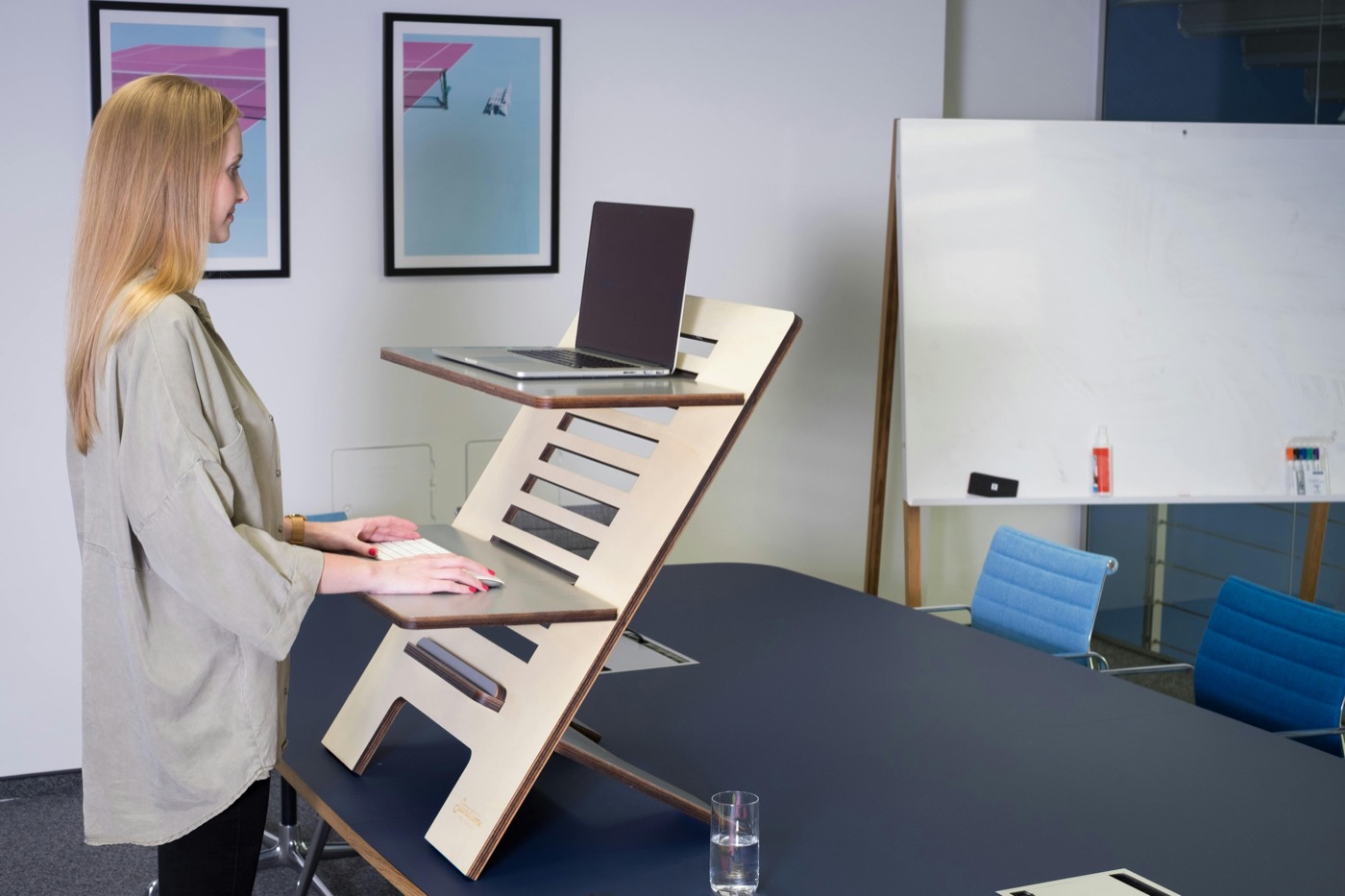
Height-adjustable standing desks solve the problem of standard desk heights by allowing you to dial in the exact measurement down to the millimeter, whether sitting or standing. However, the same biomechanical rules apply when standing.
Finding the Sweet Spot While Standing
When you transition from sitting to standing, your ideal typing height changes.
- Stand Naturally: Wear the shoes you typically wear while working (or anti-fatigue matting). Stand with your weight evenly distributed.
- Position Your Arms: Let your upper arms hang relaxed and bend your elbows to 90 degrees.
- Adjust the Desk: Raise or lower the desk until the keyboard meets your fingers without you having to lift your shoulders or drop your wrists.
For a 5’8” person, the sitting typing height might be 26.5 inches, while the standing typing height will generally be around 41 to 42 inches (104 to 106 cm). It is vital to use the memory presets on your standing desk to save these specific measurements so you don’t have to guess every time you change positions.
Practical Advice for Maintaining Perfect Typing Posture
Achieving the correct desk height is only part of the ergonomic equation. Your surrounding hardware must align with this baseline.
Monitor Height in Relation to Desk Height
Once your desk is set for perfect typing, you must evaluate your monitor position. Often, when users lower their desk to the correct 25 or 26 inches for typing, their monitor becomes too low, forcing them to crane their necks downward.
The top third of your monitor screen should be at or slightly below your eye level when you are sitting up straight. If you have lowered your typing surface, you will likely need a monitor arm or a stand to elevate the display independently of the keyboard. This separation of input (keyboard/mouse) and output (monitor) heights is the secret to total ergonomic alignment.
Keyboard Placement and Mouse Position
Your keyboard should be positioned directly in front of you. If you use a keyboard with a numeric keypad, the “G” and “H” keys should be centered with your belly button. The mouse should be immediately adjacent to the keyboard on the same level. Reaching up and out to use a mouse on a different surface level will cause asymmetric shoulder strain.
Micro-Breaks and Movement
Even with the absolute ideal desk height for typing, remaining static for eight hours will cause fatigue. Blood flow requires movement. Implement the 20-20-20 rule to reduce eye strain, and take a 2-minute movement break every 30 to 45 minutes. Drop your arms entirely, shake out your wrists, and perform gentle neck retractions to reset your posture.
Conclusion
Understanding what is the ideal desk height for typing transforms your workstation from a source of daily pain into a tool that supports your productivity. Remember that standard 29-inch desks serve a very small percentage of the population properly. By prioritizing the 90-degree elbow rule and neutral wrist alignment, and by utilizing tools like keyboard trays or height-adjustable desks, you can customize your environment to fit your unique physiology. Protect your joints and muscles by taking the time to measure your optimal typing height today.
Frequently Asked Questions
Is it better for a desk to be too high or too low?
Neither is ideal, but a desk that is too high is generally worse for typing. It forces shoulder elevation, upper back tension, and wrist extension, which rapidly compress nerves. A slightly lower desk allows the shoulders to remain relaxed, though it may cause a slight forward lean.
Should my forearms rest on the desk while typing?
No, your forearms and wrists should ideally hover slightly above the keyboard while actively typing. Resting the heel of your palms on the desk or a wrist rest while typing restricts the mobility of your hands and forces your fingers to stretch awkwardly. Wrist rests should only be used during breaks from typing.
How do I type ergonomically on a laptop?
Laptops are ergonomically flawed because the screen and keyboard are attached. To achieve the ideal desk height for typing on a laptop, you must use an external keyboard and mouse. Place the external keyboard at your elbow height and elevate the laptop on a stand so the top of the screen is at eye level.
Does the thickness of the keyboard matter?
Yes, keyboard thickness directly impacts your typing height. Mechanical keyboards can be over an inch thick, raising your hands higher and requiring the desk surface to be lower to compensate. Low-profile keyboards reduce this discrepancy and are often easier to maintain neutral wrists with.
What is negative keyboard tilt?
Negative tilt means the top edge of the keyboard (where the function keys are) is angled downward, away from you. This matches the natural downward angle of your forearms when sitting, keeping your wrists perfectly straight. Positive tilt (using the kickstands on the back of the keyboard) actually increases wrist extension and is not recommended for touch typists.
Recommended on Amazon
Looking for the gear mentioned in this guide? Check these top-rated picks on Amazon:
As an Amazon Associate we earn from qualifying purchases.